Emily Dickinson

Jascin N. Leonardo Finger • February 13, 2017

At a young age, I was given a book of Emily Dickinson’s poems illustrated specifically for a child. It was given to me by friends of my parents – they had all been good friends in high school. Their daughter and I became friends as well. We always celebrated New Year’s together by staying at one another’s houses overnight – swapping the place each year. That ended when the couple divorced and slowly over time, we did not see them much anymore.  I still have that book however. It left an impression on me – particularly “I’m Nobody! Who are you?”


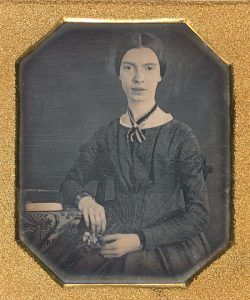
Emily Dickinson is of course infamous for being a so-called recluse . . . which is not true. Her poetry continues to be studied and her life to inspire books – fiction and non-fiction. Currently, a new exhibition has opened at the Morgan Library and Museum in New York City (http://www.themorgan.org/exhibitions/emily-dickinson)

spurring on more interest in her life and her work. Being a Mount Holyoke College graduate, I also have a further interest in her – though she only attended for about a semester. One year while I was at MHC, my Mother and I visited her home, which is a beautiful historic house museum in Amherst, Massachusetts.

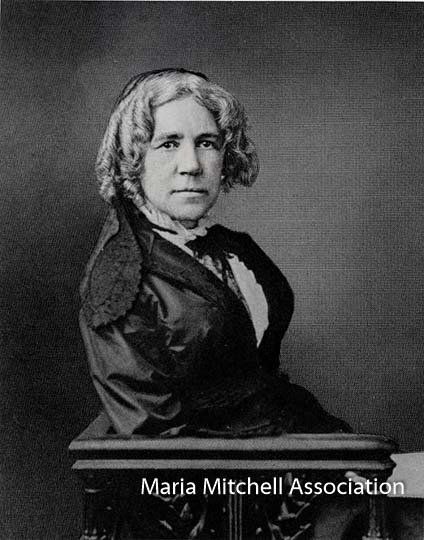
You probably wonder why I mention her here. While their paths did not cross, I am most assured in my mind that Maria Mitchell would have read her poetry and Emily Dickinson would be most aware of Maria Mitchell and her accomplishments. Dickinson would have been 17 when Maria discovered her comet and as one who attended a woman’s college (called seminary then), she would have been greatly aware of the creation of Vassar Female College and Maria’s work there. Dickinson even had a copy of The Marble Fawn by Nathaniel Hawthorne – a volume that refers to a lady scientist – Maria being the inspiration.


I am happy to say that, today, we have been reunited to some extent with the people I mentioned above when first opening this post. My Mom and her friend are in regular contact with one another and this friend has been an enormous emotional support. The couple’s daughter and I talk sporadically as well. She now passes her son’s clothes down to my son and funnily enough, we realized that over the year’s we have been visiting the same spot in Maine and staying in the exact same bed and breakfast but just two months apart! Moreover, every time over the years when I look at that book of poetry, I think of them. Funny how Emily has kept me connected.


JNLF

Recent Posts
By Jascin N. Leonardo Finger March 30, 2026
1882. Mch.13.3 p.m. I start for Faculty. As I sit, I feel as well as I ever did in my life; I go to Faculty and we probably shall elect what we called the “honor” girls. I dread the struggle that is pretty certain to come . . .The whole system is demoralizing and foolish. Girls study for “prizes” and not for learning when “honors” are at the end. The unscholarly motive is wearing. Maria Mitchell once said, “You cannot mark the human mind because there is no intellectual unit.” She did not like grades or prizes as you can see by her words above. I have to agree. Whether it be in academics or sports or some other activity, you should be rewarded in what you learn and how well you do – not to achieve a prize at the end. It’s the same idea with giving prizes to everyone so no one feels left out – just don’t do it. Learn how to lose gracefully.  JNLF
By Jascin N. Leonardo Finger March 23, 2026
March is Women’s History Month – though all months should be women’s history month! Maria Mitchell was one of the founders of the Association for the Advancement of Women (AAW), was its president for a term (1875), and founded its Science Committee which she chaired for the remainder of her life. When the fourth Congress of the AAW met in Philadelphia in October 1876, Julia Ward Howe (also a friend of Maria’s) was serving with Maria on the executive committee. Maria presented a paper, “The Need for Women in Science.” In it she stated, Does anyone suppose that any woman in all the ages has had a fair chance to show what she could do in science? . . . The laws of nature are not discovered by accidents; theories do not come by chance, even to the greatest minds; they are not born of the hurry and worry of daily toil; they are diligently sought, they are patiently waited for, they are received with cautious reserve, they are accepted with reverence and awe. And until able women have given their lives to investigation, it is idle to discuss the question of their capacity for original work. She is not saying that women cannot be scientists – she is saying they need to be given the opportunities. Maria was incredibly busy with the AAW – it took up a great deal of her time – and at the next meeting in November of that year some aspects of the meeting were wonderful according to her account –“excellent” papers, “newspapers treated us very well. The institutions opened their doors to us, the Centennial gave us a reception. But – we didn’t have a good time!” It appears there was discord among the women. A few opposed the subject of “Woman Suffrage,” but Lucy Stone was able to present her paper on the subject despite this. And, some women felt that the West was not well represented and was overshadowed by New England, thus women representing the western states protested the nomination and election of Julia Ward Howe as president of the AAW. But she won. Whew! It was not always easy and controversies constantly abounded with many schisms over time within the women’s rights movement. I often wonder what Maria might think of the place of women today – how far things have come from her time or would she be surprised that there still is inequality? What would she think? In honor of Women’s History Month, visit the National Women’s History Alliance, the National Women’s History Museum, and the National Collaborative of Women’s History Sites. These places will also point you in the directions of women’s history sites across the country and how to find out more information about all these women who paved the way for us!  JNLF
By Jascin N. Leonardo Finger March 17, 2026
For several years now, we have been teaming up with the Nantucket Historical Association in March for Women’s History Month. We visit each senior living or meeting site on island – five in all over the course of the month. We work to unique history of the place of women in our community then and through today – an incredible legacy that in the nineteenth century and earlier was quite unusual. We highlight women from all walks of island life, their accomplishments, and how they helped and influenced others. You see, Maria Mitchell was not the only incredible woman that Nantucket produced. For example, Eliza Codd was the island's first woman architect - and the leading architect on island when she practiced. Nantucket women shared their knowledge, path, support, and guidance with others both here and away and became major influences in the rights of women, women’s education, and the general place of women in society. Pretty incredible for such a small island! JNLF
Show More