
Maria Mitchell In Her Own Words

Jascin N. Leonardo Finger • April 6, 2020

Dr. E. P. Miller’s

37, 39 West 26th Street

New York, Ap. 16 {1881}


My dear Matthew {Barney},


I am glad you are getting along decently well.  I am very much better than I was and begin to enjoy life again.  Lydia Dame is with me for a few days.  Anne you probably see; she left Thursday.  I enjoyed her visit very much . . . .


Yesterday (Good Friday) the city was packed and crammed and I suppose it will be on Sunday . . . .


Tomorrow (Sunday) Lydia expects to go to Trinity {Church}; probably she will have to stand.  After Easter has passed, I mean to buy Easter Eggs.  I suspect they will be cheap.  The streets are exceedingly pretty; some of the Easter cards are very pretty and the roses beautiful.  You pass thousands of them on Broadway.


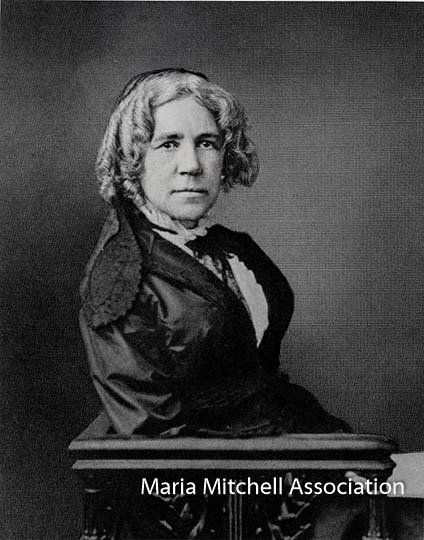
Matthew Barney was the husband of Maria’s older sister, Sally Mitchell Barney, who died in 1876.  By this point, Matthew was remarried.  He is buried on Nantucket with his second wife and her family.  It is nice to see that they still remained close – he was, after all, her brother-in-law for thirty-eight years before Sally died – a death not unexpected as her health had been poorly much of her life.  Lydia Dame, was a daughter of Maria’s youngest sister, Eliza Katherine (Kate) Mitchell Dame and Anne is of course a younger sister of Maria’s.

What I find funny is Maria’s frugal nature coming out in her note about buying Easter candy AFTER Easter.  Such a Maria thing.  She was not poor by any means, leaving a decent estate to her family when she died in 1889.  But her Nantucket and Quaker-self shine through in this comment – as too does the over-crowding.   In this date of COVID-19, it immediately makes me think of “social distancing.”  Maria might find it amazing to see shots of what were once crowded areas of NYC and Boston –  all now empty because of this virus pandemic.


Maria was in NYC for the Easter parade – this was at its beginnings – and went on for decades though it began to fizzle out in the last decade or so.  If you have never seen “Easter Parade” with Fred Astaire and Judy Garland it really is a must no matter what your religious belief – it is not a religious-based movie and it has one of the best dance and song scenes in a musical – “A Couple of Swells” – (says this movie musical nut) and “Stepping Out With My Baby” is  fantastic – can’t go wrong with Irving Berlin!  And if you have never seen Anne Miller tap dance, this one is even more important to watch!


JNLF

Recent Posts
By Jascin N. Leonardo Finger February 2, 2026
Maria Mitchell once said, “When I see a woman sew, I think, what a capacity she has for using a micrometer!” So, maybe what I am about to write would be a bit disappointing to her. However, I believe she was likely pleased by what sewing circles on Nantucket could accomplish for her fellow Nantucketers. As, the great-granddaughter of a milliner and extremely talented seamstress (she hand-smocked about twenty dresses for me when I was an infant and did all of that with rheumatoid arthritis!) and the granddaughter of two talented women of sewing and needlework, my apologies to Maria . . . . The sewing circles that arose on Nantucket in the nineteenth century were formed in part because of the Great Fire of 1846, which, along with the demise of whaling and the lure of the Gold Rush, helped to bring about an economic depression that would last decades and cause Nantucket’s population to decrease from its height of around 10,000 in the 1830s to fewer than 2,000 people by the late nineteenth century. The sewing circles helped struggling families by providing them with clothes, food, and even paying their rent. Many of the organizations rose from within the churches of the island and all were founded, managed, and run by women. The Ladies Union Circle of the First Congregational Church, established in 1846, was followed by similar groups, such as the Unitarian Sewing Society and the Ladies Wesleyan Society of the Methodist Episcopal Church, both established in 1850. The women gathered together to create, sew, and sell their creations to raise money for those in need and for their own churches. The groups not only generated the money to help others; they also provided a social venue for those who remained on Nantucket and witnessed the quickly deteriorating social fabric of their island home. The societies served as a positive network and support group for their members. The women’s activities, accomplished many good deeds, and one group, the Unitarians, was even able to purchase a parish house for the church with funds they raised – no small task. Additionally, the sewing circles gave rise to other groups that many islanders heavily relied upon in the nineteenth century: the Relief Association, the Children’s Aid Society, and the Ladies Howard Society, which could date its beginnings to the era of the American Revolution. The Relief Association is still in existence today; assisting island families in need. The act of helping your fellow islander is something that has been a constant on Nantucket, back to when the first English came to the island to settle in 1659. Some of it is born of the isolation of the island, but it is largely that the island is akin to one big family and that is what you do, you take care of your family. JNLF
February 1, 2026
“If you don’t look, you don’t see. You have to go and look.” -Edith Andrews
By Jascin N. Leonardo Finger January 26, 2026
January 18, 1858. Before I left Marseilles I took a carriage and with Miss Shepard and the Hawthorne children visited the best parts of the city and then the seaside . . .On Sunday morning {January 17} at 8 o’clock we left Marseilles for Genoa and Leghorn, uncertain what our further destination would be. Mr. Hawthorne’s indecision is so great that the termination of our journey together is very uncertain . . . I have noted before that Maria Mitchell would travel through parts of Europe with Nathaniel Hawthorne, his wife, Sophia Peabody Hawthorne, and their children. She expressed her frustrations with Hawthorne – as you can see above – in multiple ways. Further on she notes, that if he had been, “as agreeable in conversation as he is in writing“ which gives you a deeper insight. Here was America’s first woman astronomer getting an intimate experience with the Hawthorne family. She did become quite close to Sophia and the children and I have noted before, Maria would act as their impromptu governess or teacher. Hawthorne was finally swayed in making a decision when his daughter, Una, noted that both Maria and Miss Shepard desired visiting Rome as did she. JNLF
Show More