Maria Mitchell In Her Own Words

Jascin N. Leonardo Finger • June 26, 2017

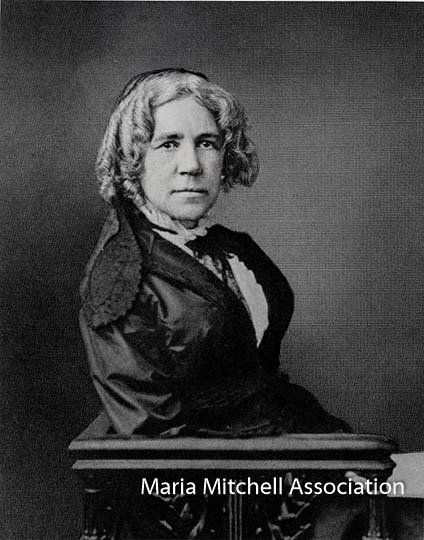
June 21, 1883. I set out on the Mary Power on June 18 th for Boston, got to N.Y. at 11a.m. and went on board the boat at once.  I disliked my stateroom and decided to go by land as it stormed.  I left N. Y. at 10:30 and worried half-sleeping through a hot night.  I reached Kendall’s just as they were at breakfast.  How glad I was to find them all well, and the same at the Dame’s and the Barney’s the next day.


Today I have been at the Bond’s to look at chronometers want one at $200 which has been tested and is only about 6 years old.  Its rate is remarkably steady even when at sea.  Also, I bo’t a mantle, a head dress and a fancy pink shawl . . .


As I have noted before, though born on an island, Maria did get seasick on occasion.  I too – even though I have travelled between Hyannis or Woods Hole and Nantucket since I was 1 ½ years old – get sick as well in rough seas.  Thus, I am not surprised she changed her mind.  The rough seas added to her distaste for the stateroom that she would stare at for a day or so seasick.  Why not go by land?!  Upon reaching Boston, she arrived at the Kendall household – the home of her sister Phebe and her husband Joshua.  The Dames and Barneys were family as well.  Her oldest sister, Sally, had married Matthew Barney.  With Sally now long deceased, this reference to the Barneys may be Maria’s nephew William Mitchell Barney, Sally’s son.  And the Dames refers to Maria’s youngest sister, Kate, and her family who lived in Lynn, MA.


A trip to Boston was to see family but also to make purchases in a place that was slightly more familiar.  A place where she knew the telescope and chronometer makers and had a relationship with them.  A chronometer was a clock that could be taken to sea and not be affected by the roll of the ship – thus she notes how “remarkably steady” it is.  Something that would be quite important for a chronometer.


JNLF

Recent Posts
By Jascin N. Leonardo Finger March 23, 2026
March is Women’s History Month – though all months should be women’s history month! Maria Mitchell was one of the founders of the Association for the Advancement of Women (AAW), was its president for a term (1875), and founded its Science Committee which she chaired for the remainder of her life. When the fourth Congress of the AAW met in Philadelphia in October 1876, Julia Ward Howe (also a friend of Maria’s) was serving with Maria on the executive committee. Maria presented a paper, “The Need for Women in Science.” In it she stated, Does anyone suppose that any woman in all the ages has had a fair chance to show what she could do in science? . . . The laws of nature are not discovered by accidents; theories do not come by chance, even to the greatest minds; they are not born of the hurry and worry of daily toil; they are diligently sought, they are patiently waited for, they are received with cautious reserve, they are accepted with reverence and awe. And until able women have given their lives to investigation, it is idle to discuss the question of their capacity for original work. She is not saying that women cannot be scientists – she is saying they need to be given the opportunities. Maria was incredibly busy with the AAW – it took up a great deal of her time – and at the next meeting in November of that year some aspects of the meeting were wonderful according to her account –“excellent” papers, “newspapers treated us very well. The institutions opened their doors to us, the Centennial gave us a reception. But – we didn’t have a good time!” It appears there was discord among the women. A few opposed the subject of “Woman Suffrage,” but Lucy Stone was able to present her paper on the subject despite this. And, some women felt that the West was not well represented and was overshadowed by New England, thus women representing the western states protested the nomination and election of Julia Ward Howe as president of the AAW. But she won. Whew! It was not always easy and controversies constantly abounded with many schisms over time within the women’s rights movement. I often wonder what Maria might think of the place of women today – how far things have come from her time or would she be surprised that there still is inequality? What would she think? In honor of Women’s History Month, visit the National Women’s History Alliance, the National Women’s History Museum, and the National Collaborative of Women’s History Sites. These places will also point you in the directions of women’s history sites across the country and how to find out more information about all these women who paved the way for us!  JNLF
By Jascin N. Leonardo Finger March 17, 2026
For several years now, we have been teaming up with the Nantucket Historical Association in March for Women’s History Month. We visit each senior living or meeting site on island – five in all over the course of the month. We work to unique history of the place of women in our community then and through today – an incredible legacy that in the nineteenth century and earlier was quite unusual. We highlight women from all walks of island life, their accomplishments, and how they helped and influenced others. You see, Maria Mitchell was not the only incredible woman that Nantucket produced. For example, Eliza Codd was the island's first woman architect - and the leading architect on island when she practiced. Nantucket women shared their knowledge, path, support, and guidance with others both here and away and became major influences in the rights of women, women’s education, and the general place of women in society. Pretty incredible for such a small island! JNLF
By Jascin N. Leonardo Finger March 9, 2026
I have posted this during Women’s History Month before but because it is March and again Women’s History Month, I think it’s worth repeating. It’s clever and helps to tell an important story in women’s history while giving it a bit of a 21 st century twist. It comes via the National Women’s History Project. JNLF
Show More