Score!

Jascin N. Leonardo Finger • December 12, 2023

We are an organization founded not too long after our namesake died. Just thirteen years after she died, Maria Mitchell’s family members, her friends, colleagues, and former students came together to create the Nantucket Maria Mitchell Association in 1902. In 1903, we were formally incorporated. That is pretty remarkable – and shows you the affect Maria Mitchell had on  people – her teaching, her friendship, her mentorship, her ability to inspire.


Everything began in the Mitchell House at 1 Vestal Street – all the departments – until we were given or acquired the buildings and sites that make up the MMA today. The first curators were Maria Mitchell’s cousins and their daughters; the cousins having lived at 1 Vestal Street with their parents after Maria Mitchell’s family moved to the Pacific Bank where William Mitchell was cashier. To Maria’s cousins, the House was still their home, but now a museum, and things they did were maybe a bit different than you would think for a historic house museum – and the times were different too.


Thus, items that once belonged to Maria Mitchell were also used by the fledgling organization. Her Dollond telescope, with which she discovered her comet in 1847, and her Alvan Clark telescope –were used for moon evenings in the yard – and then next door at the Maria Mitchell Vestal Street Observatory. In fact, the lenses in her Clark telescope were removed and used as the guide on the telescope in the MMO for many years. It was by chance and poking around many years ago that a conservator found the Dollond telescope’s other eyepieces in a drawer of the 1922 Astronomical Study of the MMO.


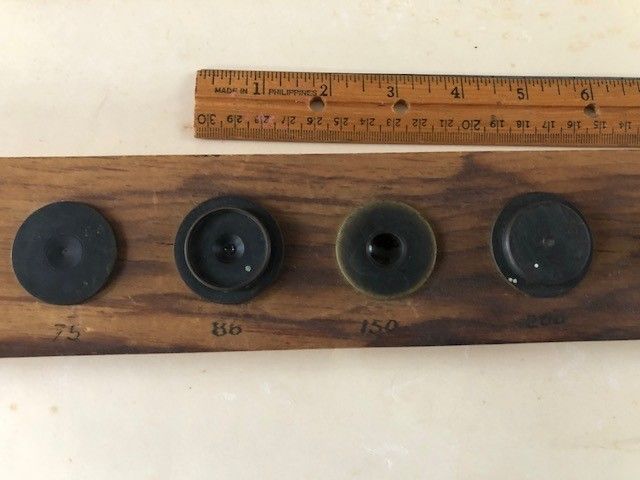
Now, it was in cleaning out the MMO’s Seminar Room (ca. 1987) for its renovation project, to be funded with a gift from a descendant of William Mitchell, that we located these. While I am embarrassed that no one seemed to notice them, I am relieved that they were unearthed! These are the eyepieces to Maria’s Alvan Clark telescope. A five-inch refractor which she was able to work with Clark on creating when she was given $500.00 by the “Women of America,” headed by Elizabeth Peabody, in 1858. Obviously, these were used during the MMO moon nights a long time ago and then nicely put away – in a drawer. Thankfully, someone had made a wooden holder for them, thus keeping them all together. I suspect it was likely Alvin Paddock, the Coffin School principal who assisted our first astronomer, margaret Harwood, who made this “holder.” He was once a carpenter and started at the Coffin School as a teacher of woodworking. While the collections in the MMO do not fall under the Mitchell Housie collections, I am glad that these items can be reunited with the telescope and find a better home for display and storage.


JNLF

Recent Posts
By Jascin N. Leonardo Finger April 6, 2026
Well, actually replace the roof! With funding from the Community Preservation Act and the work of Lydon and Sons, Inc. the Mitchell House is getting a new roof. The current one had come to the end of its useful life. A cedar roof can last a long time – longer than asphalt – and is more historically accurate. The roof we are removing was installed in about 1992 – replacing a roof from the 1930s that was not cedar but a combination of materials that actually yes, did last sixty years. The unfortunate issue has arisen that the roofwalk (walk) has to be replaced. This is NOT the original walk – nor that old of a walk. It’s likely from the 1970s or so and has been cobbled at over time. It’s not a functioning walk – no one is allowed on it – but the Mitchell House needs it none the less. Maria Mitchell and her father, William, likely used the walk for astronomical observations – in addition to the yard – but the walk is also protected as part of the preservation easement on the House. Walks – NOT and NEVER called widow’s walks – were used for preventing and putting out chimney fire and roof fires. In a place where wood was expensive and had to be brought from “the main” these were purely utilitarian. What good Quaker (or non-Quaker) would build a platform for his wife to stare out to the harbor to see if her husband was on his way home? The other issue is that the walk was completely resting on the ridge board – and actually was notched to accept the pitch and tip of the ridge board so they couldn’t work around it. I suspect this may have been the ways walks were once built – and also a crafty and smart thinking carpenter who came up with the idea. It makes the walk lower. But between that issue and the age of the walk and then the blizzard of February 2026 that packed gusts over 83 MPH (that’s Category 1 hurricane winds) the walk gave in. Balusters had been knocked out and the railings were loose and pulling away from the posts. So, we will also be working with Barber and Sons to create a new roofwalk – and they agreed to do this for us quickly which is also no small feat given how busy everyone is these days. So from the bottom of the Mitchell House’s heart (and mine) a big thank you to Chris Lydon and Lydon and Sons and crew, Barber and Sons / Beau and Nate Barber, the Community Preservation Committee, and Nantucket Preservation Trust (our easement holder)! JNLF
April 1, 2026
“If you don’t look, you don’t see. You have to go and look.” -Edith Andrews
April 1, 2026
NANTUCKET, MA—The Maria Mitchell Association (MMA) invites the community to “Dark and Quiet: Astronomy in the Age of Satellite Constellation” presented by Dr. Joshua Reding for its April Science Speaker Series. This free presentation will take place Wednesday, April 15 from 7 – 8pm on Zoom. In the past decade, the number of active satellites in Earth’s orbit has grown by a factor of 10. This breakneck growth in the commercial space industry has turned entrepreneur, investor, and policymaker eyes to the skies, but in the process has boxed out the historic stewards of the space domain: scientists. Explorers and pioneers across human history learned that uncharted territory hides unprecedented challenges, but the consequences of decisions made towards occupying the “final frontier” do not abide by international borders. Space operators therefore ignore the warnings and concerns of scientists not only at their own risk, but at the risk of everyone living under increasingly crowded skies. In this conversation, Dr. Josh Reding will explain how astronomers are trying to inform and guide policymaking for the rapidly changing space environment, both informally through volunteer action and advocacy and formally in domestic and international policy forums. Dr. Reding is an optical astronomer by training and now a radio spectrum manager by profession. He completed his B.A. with a double major in Astronomy-Physics and Philosophy at Colgate University, and his M.S. and Ph.D. in Physics from the University of North Carolina at Chapel Hill. His research investigated unusual white dwarf stars that likely formed in stellar mergers as “failed” supernovae and he has also designed astronomical instrument components and installed them at world-class observatories. Concurrent with the completion of his Ph.D., Reding began his professional science policy career as a North Carolina STEM Policy Fellow in the NC Department of Commerce’s Office of Science, Technology & Innovation. He was then selected for the American Association for the Advancement of Science Science & Technology Policy Fellowship, which places scientists in federal offices as expert contributors to ongoing agency missions. This event will be held via Zoom. Pre-registration is required. To register for the free, virtual event, use the registration link: https://us06web.zoom.us/webinar/register/WN_5MoAybp5QHCasQ0QE5xmgQ#/registration The Science Speaker Series is generously sponsored by the Maria Mitchell Association’s lead sponsor, Bank of America. The Maria Mitchell Association was founded in 1902 to preserve the legacy of Nantucket native astronomer, naturalist, librarian, and educator, Maria Mitchell. After she discovered a comet in 1847, Mitchell’s international fame led to many achievements and awards, including an appointment as the first professor of astronomy at Vassar College. Maria Mitchell believed in “learning by doing” and today that philosophy is reflected in the MMA’s mission statement, programs, research projects, and other activities. The Maria Mitchell Association operates two observatories, a natural science museum, an aquarium, a research center, and preserves the historic birthplace of Maria Mitchell. A wide variety of science and history-related programming is offered throughout the year for people of all ages. ###
Show More