

Simply (Or, Not Simply) Messing About In Boats
In the Mitchell family’s time, Vestal Street was not a quiet place. A cooperage, a boat building shop, and the gaol (jail) were all located on what was originally referred to as Prison Lane. Around the corner on the corner of Main and Milk Streets was the Town building where at one time William Mitchell taught before he started his own private school. Add to that background noise – albeit no modern machinery so it was more pleasant – the likelihood of carts going up and down the street for these two shops with supplies and carting away their products, people walking by, other animals roaming free, and a person’s calash (cart) or even a horse – though in Town walking pretty much ruled.
The boatshop certainly interests me – as do all the other activities of course. The boatshop was located on the corner of Vestal and Bloom Streets. Boats were a bit of my world growing up. I spent a LOT of time on the ferry. And then, my Nana loved boats. She didn’t care if it was the Uncatena or a sport fishing boat, she just wanted to be on the water. I believe she went sport-fishing not to fish, but for the boat ride! She used to take us out on harbor cruises too – I remember being seasick quite often because she didn’t care what the weather was – she never got seasick, except once. Then there is me; no matter how long I have been on boats (since I was a year old basically), I get seasick in choppy seas and of course rough seas. Marrying a US Coast Guard officer did not change that – he can eat a bowl of chili and drink a cup of coffee in high seas (I’m talking 30 feet!). Ugh.
My world of boats expanded with my husband, Eric. He maintains and repairs quite a few sailboats – and a few power boats – here on the island. His focus has been mainly on wooden boats but he will do fiberglass as well. With a degree in naval architecture, he also designs and builds boats but he has never had the time to focus on building. Thanks to an expanded crew at his boatshop, they are starting to finally build – though his own designs remain on the computer for now. Nantucket once had a myriad of small boat shops – even building whaleships at Brant Point. Since the first half of the twentieth century, building has slowly begun to fade away on Nantucket. There are still a few people building and I am happy to say Eric is helping to grow that number with this venture.
They have started with a wooden boat that is excellent for the waters around Nantucket – a Haven 12 ½. 12 ½s were originally designed by Nathanael Herreshoff – the “Wizard of Bristol” – who is also the original designer of the Alerion which now graces Nantucket’s waters and my husband repairs and maintains. Herreshoff’s 12 ½ was a full keel boat which is not good for shallow waters. The Haven 12 ½ was designed by Joel White, a naval architect and boat builder from Maine who was also the son of author, E. B. White – yes, THAT E. B. White. The Haven is a centerboard boat – meaning it is good for shallow waters because it does not have a full keel – the centerboard acts as the deeper full keel would but can be raised and lowered at will by the sailor to keep the boat safe from running aground in shallow waters.
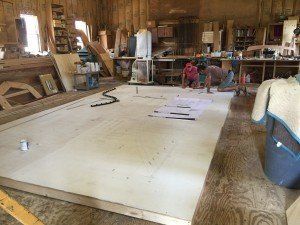
Eric and his crew are currently lofting the boat. After building a platform, they began the painstaking process of drawing out the lines plans of the boat on the platform – basically drawing the designer’s plan to full scale on a 16’ by 20’ wood platform. Once they have the pattern all drawn out they can then begin the process of making molds for the frames which you see here in this image.
What, do you say, does this have to do with Maria? Well, it’s a little piece of what she would have seen more regularly as boatshops popped up even in backyards as boat builders built whaleboats and dories and then other small craft for fishing to fill the need. She would have been able to see the whaleships being built at Brant Point and she and her father, William, certainly had a hand in whaling – William rated the chronometers for all the whaleships homeported on Nantucket (roughly ninety) and thus likely rated every chronometer on Nantucket – and those of visiting ships as well. When she was 14, Maria started that same task on her own. And, her brother, Andrew, ran away to see as a young teenager and would later serve on a ship during the Civil War. Boatbuilding is one of the oldest trades in the world and there are some on island who continue to ply this trade. It reminds one of the past. Stay tuned – I will keep you up to date from time-to-time on the building.
JNLF
Recent Posts