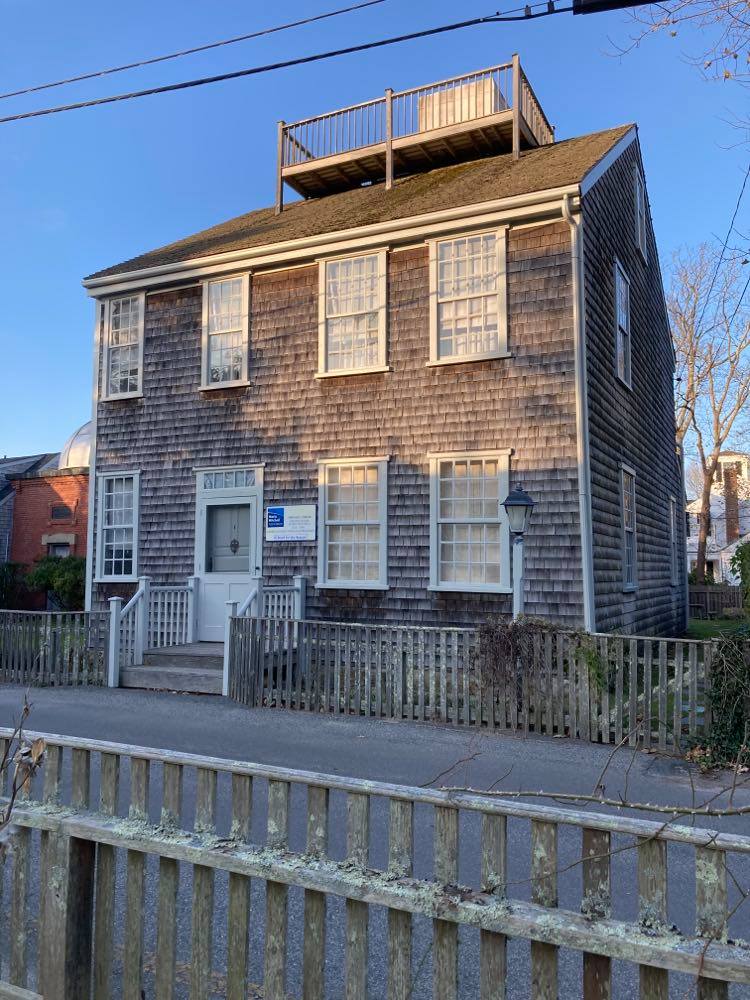
The Mitchell House in Autumn

Jascin N. Leonardo Finger • September 17, 2012

Vestal Street is quieter. There are fewer tourists, summer residents have returned to their year-round homes especially if they have children in school, and the air is cooling and becoming more crisp. For Mitchell House, we are still open for tours although on a shorter schedule (this year on Saturdays from 10-1PM), but there are still many things to accomplish before it gets cold and I have to seek a winter office – one that has some heat!


As I noted last year, I always find closing up the House depressing. But at this time, it is still open with everything in its place and I am able to focus on some more detailed cleaning and the conservation of small artifacts, working more in-depth with the collections, and working on other House related projects. I will also be out in the garden even more as I cut back this year’s perennials and annuals, making things neat and tidy for next spring when I wake the garden up and add annuals, a few new perennials, and a bounty of wonderful heirloom seeds such as the morning glories you see in this image that I planted at the south fence along Vestal Street. I am hoping that next year, the fig plant will have some figs – William Mitchell had a fig plant in the garden when he lived at 1 Vestal Street and I have been trying to introduce plants he had in his garden.

We still have some historic preservation workshops coming up. We just had a “Behind-the-Scenes at the Mitchell House” with NPT – an architectural and conservation focused workshop that had a nice group of people on such a beautiful day. And, we have two more to come.

On the 22nd of September, I will join with the Executive Director of Nantucket Preservation Trust (NPT) and Education Staff from the Nantucket Historical Association to present our “Four Centuries of Domestic Life” walking tour. It starts at 10am at the Oldest House, ending on Main Street. It’s an interesting way to learn more about the changes in the built and natural environments and how changes in domestic life changed these landscapes. And, it is free!


And on October 6th Mitchell House and NPT will co-host island conservation plasterer and mason Pen Austin as she discusses the preservation and conservation of historic masonry using the Mitchell House chimney and the chimneys and fireplaces of several houses nearby. Come and learn how to slake mortar! It is $5 for members of MMA or NPT and $10 for Non-Members. AND, reservations are necessary due to very limited space, so please call me at the Mitchell House to reserve a spot at 228.2896.


We hope you will join us, for a tour on Saturday mornings in September or for one of the remaining workshops!


JNLF


Recent Posts
By Jascin N. Leonardo Finger December 9, 2025
Another re-blog. I came across this recently while looking through my computer files. I want to re-blog it in memory of Jean Hughes, an incredibly gifted islander, who was directly influential in the lives of so many island children and those in need. She was the Coffin School Trustee’s President for many years and I had the honor to serve as a trustee under her. She passed away in the summer of 2025. Jeanie loaned me this from her family collections as she thought I would enjoy it. She knew me better than I thought she did. With love. 1830s Chinese silk to be exact. It literally floated into my lap as I sat reading a letter.  A letter from a young Nantucket girl to her grandparents. A young girl who just several years before had moved from tiny Nantucket Island to San Francisco with her mother to join her father. He had moved for better work and a better life. Nantucket was in an economic decline. Reading this treasure trove of letters – loaned to me by a friend who is a descendant of these people I mention – was like spying on them. Now, when I read Mitchell family letters and writing it is slightly different for me. Having worked in the Mitchell House for so long, I feel like they are a part of my family. This batch of letters was different however. I felt like they know I read their letters – as if they were looking over my shoulder or sitting on the other side of the room aghast. I felt like they thought no one ever would – or at the very least an outsider – read this correspondence. The worse letter one was the son writing to his mother upon receipt of her letter telling him of his father’s death. That was hard. Made harder because he thought his father was fine – he was as of the last letter a month or two before. Made harder as I lost my own Father a little over a year ago. I knew how he felt – but cannot imagine receiving a letter that is about a month old telling one of such horrible news. He had not seen his father in several years. I could speak to my Father, visited him monthly, and was there with him. That was not an easy letter to read. The silk fabric piece is quite beautiful – and still pristine – as if it was just folded into the letter yesterday. She wanted to share with her grandparents the dress that her cousin had brought to her directly from Hong Kong. A cousin, who was likely pregnant – or “sick” as was written but it was obvious what “sick” meant (yes, pregnancy was looked at as an illness in a way – and there were high rates of infant and mother mortality during and immediately following birth). The cousin had travelled back and forth to Hong Kong on the China Trade with her husband it seems but due to the pregnancy had to be put off with family or others until the baby was born. This was a common practice for the wives of whale captains who might go to sea with their husbands. They were put off with other whaling families or missionaries in far off ports so that they could have their baby where others could help. Sometimes they were put off months in advance. And, did you know that Nantucket whale wives were the FIRST to go to sea with their captains husbands? They set the trend – after all, we were the whaling capital of the world. At least, until we lost that title for multiple reasons. I digress. The other piece that leads one to realize that money was to be had – at least for the cousin – is that she didn’t bring fabric – she brought the dress already made in Hong Kong. Yes, it would have been less costly there than in the United States but it shows there was extra money for spending. And, there was enough excess fabric inside the dress for this young girl to cut off a piece of it and send it to her grandparents. Making them feel as if they were a part of her daily life – and making her feel that way too. So far from home. On the other side of the continent with Nantucket Sound in the midst, to boot. JNLF
December 1, 2025
“If you don’t look, you don’t see. You have to go and look.” -Edith Andrews
By Jascin N. Leonardo Finger December 1, 2025
A past blog that I forgot I had written when I came across the letter written about below. Once I realized I had already written a blog about it, I decided it was worth re-blogging. Over Christmas, a neighbor of my Mother’s gave her a copy of something she came across while cleaning things up in her house. She thought my Mother would enjoy it and by the same token, my Mother thought that I would. Her note with it stated it proved she was as, “old as dirt.” She isn’t old as dirt. Believe me. The letter she had copied was from the War Production Board and dated December 16, 1942. It was, “written at the request of President Roosevelt,” who wanted to thank this young girl for her donation of a rubber tire. This was not any old rubber tire you see. It was a pure rubber tire – very much needed for the war effort – from one of her toy airplanes and measured not more than half an inch or so in diameter. This young girl was distressed that everyone else, including in her family, was assisting in the war effort and that she wasn’t. So when she discovered the tire was rubber, she asked her mother to send it to Washington, DC. Which, obviously, her mother did do. What does this have to do with Maria Mitchell you wonder? Well, it makes me think of collections and saving things. You have your own collections and archives at home – your family papers and photographs, your books (aka special collection books). These are valuable to your family and its history. They help you see what and who came before you and how your family became a family. What they endured. How they got to where they did and how where they came from helped, in part, to get you to where you are today. And then, these papers and books are important for the larger community. We learn from our past and our collective past – and these items help us do that. Scores of researchers use Maria Mitchell’s papers and those of her family every year. Not everyone is doing research on the family – they can be doing research on astronomy or some science-related matter, someone whom Maria or her family knew. The possibilities are endless. So, from this little letter, I know a young girl in Connecticut contributed to the war effort and what she gave. I know that rubber (not that I didn’t already but you get the idea) was important to the war effort in some way. I also know that many people contributed to the war effort and this was just one simple way to do it. I know she had a toy that had rubber components. And as a young girl in 1942, she was playing with toy airplanes. And I know that the war effort was all consuming to the point that a small child wanted to make sure she found a way to help too while seeing her family members helping. Your paper is important. Always find a venue for these items if you no longer want them. They will help us to better understand our world – past and present. JNLF P.S. Remember that every donation, every gift to someone in need, matters. No matter how small it is – or you think it is.
Show More