The Nantucket Maria Mitchell Association Announces International Dark Sky Week April 2 - 8

March 13, 2024

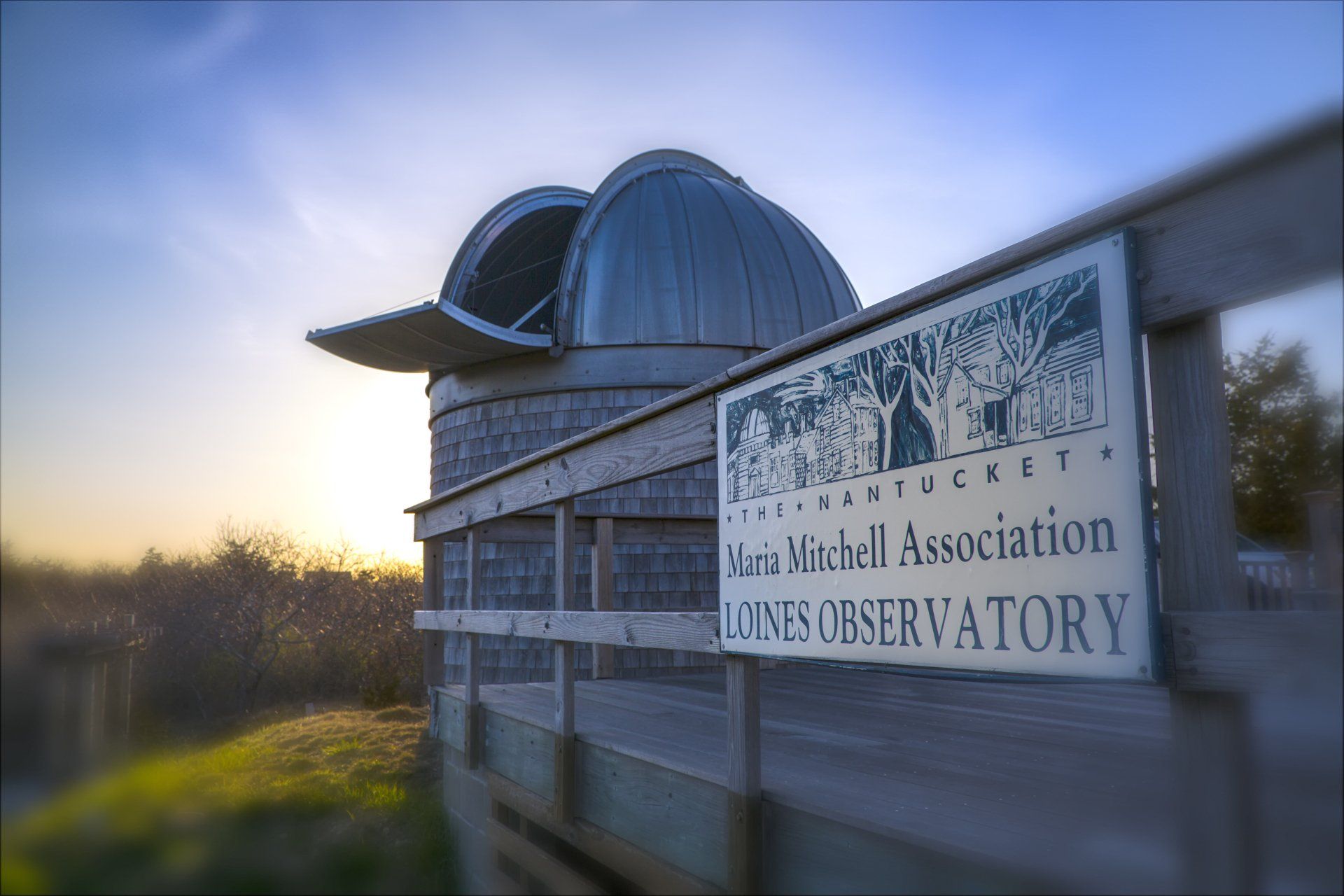
NANTUCKET, MA—The Nantucket Maria Mitchell Association (MMA) announces it will celebrate DarkSky International’s International Dark Sky week, slated for April 2-8, 2024. In honor of this event, the MMA will host a free public Stargazing Open Night at Loines Observatory, 59 Milk Street Extension, on Thursday, April 4, from 8-9pm. This stargazing program is designed to be engaging and interactive for all ages but with a focus on young adults and students of K-12 grades. Registration is required and can be found at: https://112458a.blackbaudhosting.com/112458a/Look-Up-at-Loines-04Apr2024


Keep your eyes peeled for other Dark Sky week activities happening with the MMA on our calendar: https://www.mariamitchell.org/calendar.


International Dark Sky Week was founded in 2003 by then-high school student, Jennifer Barlow, with the goals of reducing light pollution and raising awareness about its effects on the night sky, encouraging the usage of better and safer nighttime lighting systems, and promoting the study of astronomy. The mission of DarkSky International is to promote, “Win-win solutions that allow people to appreciate dark, star-filled skies while enjoying the benefits of responsible outdoor lighting.”


“This year, International Dark Sky week overlaps with the celestial event of the year – the Great North American solar eclipse happening on April 8. We encourage everyone to safely enjoy the partial solar eclipse from here on Nantucket during the daytime, and then to check out Nantucket’s fantastically dark skies at night!” states Dr. Regina Jorgenson, the MMA’s Director of Astronomy.


You can find more information about DarkSky International on their website: https://darksky.org/, about International Dark Sky Week: https://idsw.darksky.org/,

and about Nantucket Lights at their website: https://nantucketlights.org/.

For more information regarding the MMA’s activities around the Great North American Eclipse on April 8, please visit our calendar at https://www.mariamitchell.org/calendar.


The Maria Mitchell Association is a private non-profit organization. Founded in 1902, the MMA works to preserve the legacy of Nantucket native astronomer, naturalist, librarian, and educator, Maria Mitchell. The Maria Mitchell Association operates two observatories, a natural science museum, an aquarium, a research center, and preserves the historic birthplace of Maria Mitchell. A wide variety of science and history-related programming is offered throughout the year for people of all ages.


                                   ###

For Immediate Release

March 22, 2024

Contact: Molly Mosscrop

mmosscrop@mariamitchell.org

Recent Posts
By Jascin N. Leonardo Finger July 20, 2026
Being Nantucket, we tend to stay cooler than the mainland in the summer though the humidity is often over the top. It often makes me think about people in the nineteenth century and earlier – heck, even well into the mid 1900s, and how they handled the weather. With climate change, we have warmed and our weather is more severe and volatile at times. Instead of a nice gentle rain, we get a deluge and the ground has trouble absorbing that sort of onslaught. But they did did still have heat and humidity – and think of a fire in the hearth all day and the bake oven – if it was a baking day. And now, think of the women standing in front of the firebox and bake oven, or even a cook stove later on. I am sure if the confines of their home, alone, les could be worn but for the most part, those women still had a lot of layers on. I am sure that a cloth dipped into or run under the mouth of the pump and wrung out gently – to keep as much as the cool, moisture as possible – was tied around a neck or stuffed down a dress front (or even in addition to the wet neckerchief).  At the Mitchell House, we get a little of the feeling for this. We have no HVAC in the House so we rely on doors being open – with screens to keep the bugs out – and the roofwalk opened (also with a screen) so that air circulates throughout the House. Air can move nicely through – the heat rises, the air moves up and out of the roofwalk hatch very much as it might have in Maria Mitchell’s day. While we do not have the added (somewhat) drying benefit of the heat of the fire in the kitchen, we do have all of the original horsehair plaster, so the House does remain somewhat cooler and drier overall. But some days, the relative humidity does get up into the 90s in the House – that’s when I say, “Get out your umbrellas!” JNLF
July 17, 2026
NANTUCKET, MA— The Maria Mitchell Association’s (MMA’s) Nantucket Harbor water-quality monitoring buoy is now part of the Northeastern Regional Association of Coastal Ocean Observing Systems, known as NERACOOS. NERACOOS is one of eleven regional associations that make up the U.S. Integrated Ocean Observing System, or IOOS, NOAA’s national ocean-observing network for gathering and sharing ocean, coastal, and Great Lakes data. This connection means that real-time data from Nantucket Harbor are no longer held only within a local monitoring program. They are now available through the NERACOOS Mariners Dashboard, where scientists, resource managers, educators, mariners, and the public can view Nantucket Harbor conditions alongside other coastal observing sites from Long Island Sound through the Gulf of Maine. The monitoring buoy carries a suite of sensors that track changing conditions such as temperature, oxygen, acidity, nutrients, and underwater light. These measurements show what eelgrass, bay scallops, and other marine organisms are actually experiencing over time. “This is an important step because Nantucket Harbor is now part of a larger coastal observing system,” said Dr. Betsy Sherman, the Maria Mitchell Association’s Senior Marine Science Advisor. “Our data can be compared with data from other sites, used in regional analyses, and placed in a broader environmental context. We are not just looking at Nantucket Harbor in isolation.” The Nantucket Harbor buoy project has been supported by the Great Harbor Yacht Club Foundation, whose early investment helped make continuous water-quality monitoring in Nantucket Harbor possible. Additional support has been provided by the Remain Nantucket Fund at the Community Foundation for Nantucket, the Osceola Foundation, the Sociable Weaver Foundation, and through collaboration with the Town of Nantucket Harbormaster. The timing is especially relevant for coastal communities because NERACOOS is also leading the newly funded NSF Seafood Engine in New England, a regional effort focused on strengthening fisheries, aquaculture, seafood technology, and coastal economies. For an island community facing changes in water quality, habitat, fisheries, and climate, joining this regional network strengthens the scientific foundation for understanding and protecting Nantucket Harbor. The Maria Mitchell Association was founded in 1902 to preserve the legacy of Nantucket native astronomer, naturalist, librarian, and educator, Maria Mitchell. After she discovered a comet in 1847, Mitchell’s international fame led to many achievements and awards, including an appointment as the first professor of astronomy at Vassar College. Maria Mitchell believed in “learning by doing” and today that philosophy is reflected in the MMA’s mission statement, programs, research projects, and other activities. The Maria Mitchell Association operates two observatories, a natural science museum, an aquarium, a research center, and preserves the historic birthplace of Maria Mitchell. A wide variety of science and history-related programming is offered throughout the year for people of all ages.  ####
By Jascin N. Leonardo Finger July 13, 2026
Finished. Finis. Completed. Done. Accomplished. The Mitchell House roofwalk is now done. Back to looking a bit more normal up on the ridgeline. But as I may have noted in the other post about the roofwalk, the one that was removed due to its condition and how it sat on the roof’s ridge was far from the original – or even a nineteenth century one. I am including an image from about 1908 or so in order for you to see the Mitchell House without a walk – even then. Now, an interesting fact is that I am able to date the undated photo because in the west image – where you see the open year – you can actually see the shadow of the Maria Mitchell Vestal Street Observatory – at the backside of the 1825 Kitchen. And given that shadow you also know its late afternoon since that side of the House, as noted, faces West. Another interesting feature is the long downspout – more like a side spout – that takes water from the front gutter, along the upper West façade of the House and across a window and then over the 1825 Kitchen roof where it terminated in a cistern – still in existence under the ground today. JNLF
Show More